Gas vs Electric Hot Water in Sydney: Which One Actually Saves You More Money?

Gas vs Electric Hot Water in Sydney: Which One Actually Saves You More Money?

Choosing a gas hot water system in Sydney could save the average household $200 to $500 per year compared to a standard electric storage unit – but the answer is not the same for every home, every suburb, or every situation. This guide compares running costs, installation costs, rebates, and real-world trade-offs so you can make the right call for your property.

Jump to: running costs, installation costs, gas vs electric comparison, rebates, system types, FAQs.

Gas vs Electric: Running Costs in Sydney 2026

Running costs are where gas hot water systems have traditionally held a clear advantage over electric storage units in Sydney. With Sydney gas prices averaging around $0.025 per MJ and electricity sitting above $0.30 per kWh for most households, heating water with gas is consistently cheaper day to day.

Here is how the numbers compare for a typical Sydney household of four people:

System Type Avg Annual Cost (Sydney) Notes
Gas storage (5-star) $350 – $450 Continuous pilot light adds cost
Gas continuous flow $280 – $380 No pilot light; heats on demand
Electric storage (off-peak) $450 – $600 Depends on tariff access
Electric storage (peak) $700 – $950 Full retail rate all day
Heat pump (electric) $180 – $280 Best efficiency; higher upfront cost
Solar hot water $80 – $180 Lowest ongoing cost; weather-dependent

Source: Australian Government Department of Energy running cost benchmarks, adjusted for current Sydney utility rates.

The key takeaway: a gas continuous flow system sits in the middle of the pack for running costs, significantly cheaper than peak-rate electric, but more expensive than a heat pump if you look over a 10-year horizon. The gap between gas and heat pump can be $1,000 or more over a decade.

What these numbers mean for your bill

If you are currently on a standard electric storage system (no off-peak tariff), switching to a gas continuous flow system could save you $300 to $500 per year. If you are already on off-peak electric rates, the saving is narrower – around $100 to $200 per year. Your actual saving depends on your household’s hot water usage, the age of your current system, and which gas retailer you use.

Installation Costs Compared

Running costs are only half the picture. Installation costs vary significantly depending on whether you are replacing like-for-like or switching fuel types.

Scenario Typical Cost (Sydney) What Drives the Cost
Replace gas with gas (same location) $1,200 – $2,200 Unit cost + 2-3 hrs labour
Install gas (no existing gas line) $2,500 – $5,000+ New gas meter + internal pipe run
Replace electric storage with electric $900 – $1,600 Unit cost + 1-2 hrs labour
Switch electric to gas (existing gas) $1,800 – $3,200 Pipe extension + compliance cert
Install heat pump $2,500 – $4,000 Higher unit cost; rebates available

If your home already has natural gas connected, swapping to a gas continuous flow system is typically the most cost-effective immediate upgrade. If your home runs all-electric, the cost to bring gas in needs to be factored into any payback calculation.

Gas hot water system installation cost Sydney - AIM LOCAL tradesperson at work

Is Gas Available in Your Sydney Suburb?

Natural gas is available across most of metropolitan Sydney, but supply varies by suburb and street. Areas well-served by the gas network include most of the Inner West, Eastern Suburbs, North Shore, and Western Sydney. Some newer housing estates in outer-growth corridors may not have a reticulated gas connection yet.

Before planning a gas hot water installation, your plumber needs to check whether a gas meter already exists at your property. If not, the connection process involves Jemena (the Sydney gas network operator) and can take three to six weeks. This waiting time matters if your current hot water system has already failed.

Our team at AIM LOCAL can confirm gas availability at your address and manage the meter application process on your behalf. We service Sydney, Central Coast, and Newcastle. You can also check your address at the AIM LOCAL hot water systems page for more information on what is involved at your property.

Types of Gas Hot Water Systems

Gas hot water systems come in two main configurations: storage and continuous flow. Each suits different household types.

Gas storage systems

Gas storage systems heat a tank of water (usually 135L to 360L) and keep it at temperature. They are well-suited to households with predictable hot water schedules, and they work well even during peak demand periods. The downside: a pilot light on older models runs 24/7, adding to gas consumption, and you can run out of hot water if demand spikes.

Gas continuous flow (instantaneous)

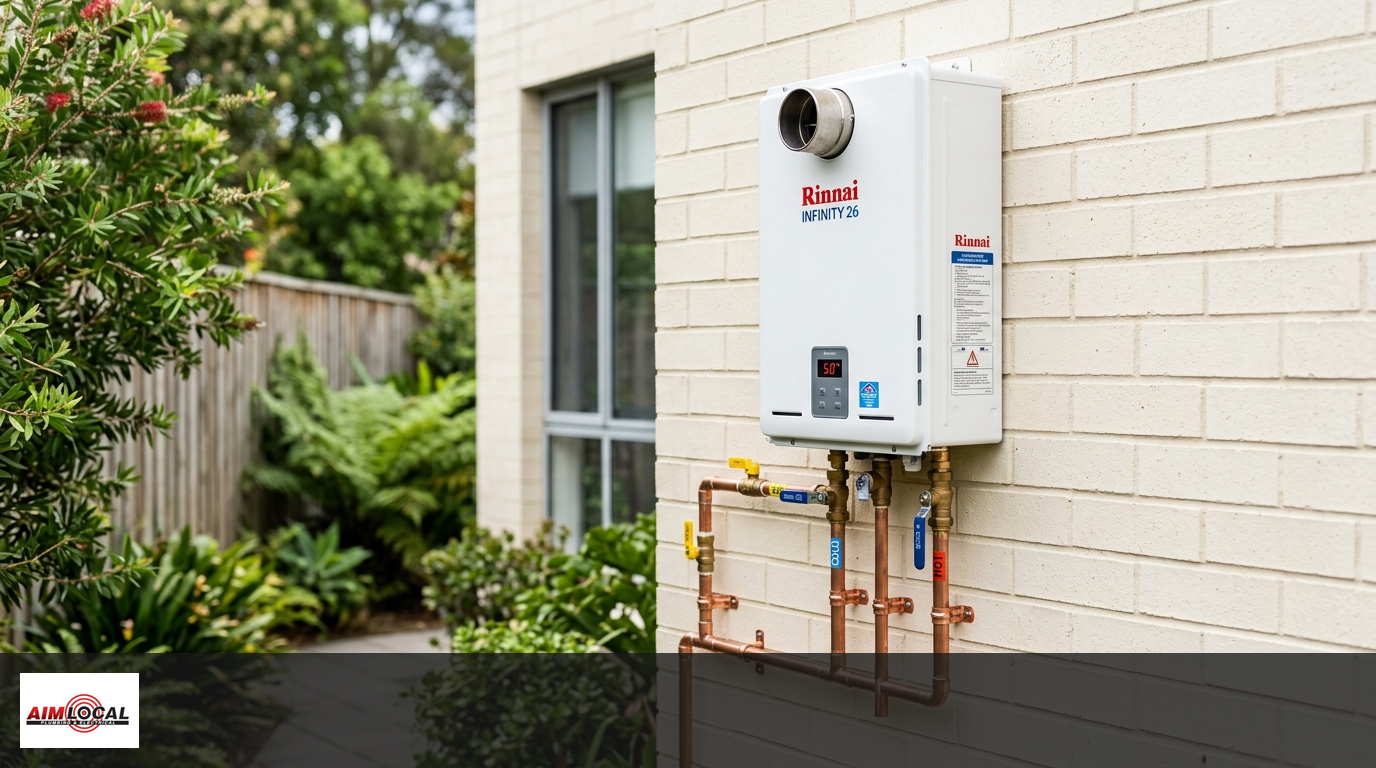
Continuous flow systems heat water on demand with no storage tank. Brands like Rinnai, Rheem, and Dux dominate this space in Sydney. They are highly efficient because there is no standby heat loss, and you never run out of hot water. They do require adequate gas pressure and flow rate, so a licensed gas plumber must assess your connection before installation. For households that have previously been without hot water, this upgrade often has the most immediate impact on comfort.

For a deeper comparison of all hot water types including solar and heat pump, see our Hot Water System Buying Guide Sydney 2026.

LPG as an alternative

If natural gas is not available at your address, LPG (bottled gas) can power the same continuous flow or storage units. Running costs are higher than natural gas – typically $100 to $200 per year more – and you need outdoor space for the gas bottles. LPG is common in semi-rural areas around the Central Coast and Hunter Valley.

NSW Rebates and Incentives in 2026

The rebate landscape in NSW is shifting. Here is what is currently available for Sydney homeowners:

Federal government Small-scale Technology Certificates (STCs)

Solar hot water and heat pump systems qualify for STCs, which reduce the purchase price at the point of sale. Gas systems do not qualify for STCs. This means the effective installed cost of a heat pump is substantially lower than the sticker price – often $600 to $1,200 lower, depending on current certificate values.

NSW Energy Savings Scheme (ESS)

The NSW ESS provides rebates when you replace an older, less-efficient appliance with a high-efficiency alternative. Upgrading from an old electric storage system to a gas continuous flow unit can qualify – your licensed plumber can facilitate the claim. Check the AIM LOCAL energy savings guide for the current rebate amounts applicable to Sydney households.

Low-income household programs

The NSW Government’s Energy Bill Relief program may provide additional support for eligible households. Call Service NSW on 13 77 88 to check eligibility if you are on a Health Care Card or Pension Concession Card.

When Electric or Heat Pump Makes More Sense

Gas is not always the right answer. Here are the scenarios where electric – specifically heat pump – makes more sense:

  • No gas connection: Bringing gas in costs $2,500 to $5,000+. A heat pump with STC rebate may cost less upfront and deliver better 10-year savings.
  • Large solar PV system: If you generate excess solar during the day, a heat pump running on a timer uses free solar electricity and can deliver sub-$100 annual running costs.
  • NSW’s gas phase-out direction: NSW has signalled a long-term move away from gas in new buildings. Installing gas now may limit resale options in coming decades.
  • Apartment living: Many strata buildings prohibit new gas connections or lack gas infrastructure. Electric systems are often the only option.

If you are unsure which direction suits your property, our team at AIM LOCAL can run through the options during an on-site assessment at no obligation. We service Sydney, Central Coast, and Newcastle. Learn more about what to look for in our hot water system autumn maintenance guide.

Need Help Choosing the Right Hot Water System for Your Home?

AIM LOCAL’s fully licensed plumbers and gas fitters service Sydney, Central Coast, and Newcastle. We’ll assess your property, check gas supply, and give you a straight answer – no pressure.

Get Your Free Quote

Frequently Asked Questions

How long does a gas hot water system last in Sydney?

A well-maintained gas storage system typically lasts 10 to 15 years. Continuous flow systems often last 15 to 20 years. Sydney’s water quality (moderately hard in most areas) can affect anode rod life in storage systems – annual checks help extend service life significantly.

Can I switch from electric to gas hot water myself?

No. Gas work in NSW must be carried out by a licensed gas fitter (Type A and Type B gasfitting licence). The connection to the gas meter, all internal gas pipework, and appliance installation must be done by a licensed tradesperson. An unlicensed installation voids your insurance and creates serious safety risks.

How long does it take to install a gas continuous flow system?

If gas is already connected at your property and you are replacing a like-for-like system, installation typically takes 2 to 4 hours. If a new gas pipe run is needed (for example, connecting to an external wall), allow 4 to 6 hours. A new gas meter connection through Jemena can take 3 to 6 weeks, so plan ahead if your existing system is ageing.

What is the best gas hot water system brand in Sydney?

Rinnai, Rheem, and Dux are the three most-serviced brands in Sydney, with strong parts availability and local service agents. For continuous flow, Rinnai’s Infinity series and Rheem’s Pronto are consistently well-rated. For storage, Rheem’s 5-star gas units deliver solid efficiency. Your plumber can advise which model suits your household’s peak demand.

Will gas hot water affect my home’s resale value?

Gas hot water is not a negative for resale in Sydney’s current market. However, buyers in inner-city areas increasingly ask about sustainability features. If your budget allows, a heat pump system with a solar PV connection may present better on a sustainability audit, which some buyers are now commissioning.

Can I get a same-day gas hot water replacement in Sydney?

Yes, in most cases. AIM LOCAL stocks the most common Rinnai and Rheem units and can often complete a same-day replacement when the call comes in before noon. Emergency replacements (failed system, no hot water) are prioritised across our Sydney and Central Coast service areas. Call us for urgent jobs.

Is gas or electric hot water better for the environment?

This depends on how your electricity is generated. On Sydney’s current grid mix (still partially coal-dependent), a high-efficiency gas continuous flow system can have lower greenhouse emissions than a standard peak-rate electric unit. However, a heat pump running on solar or off-peak renewable tariffs produces fewer emissions than either. See AIM LOCAL’s gas plumbing safety guide for more context on gas system considerations.