
As March 2026 marks the transition from Sydney’s intense summer into autumn, pool and spa owners face a critical maintenance window. After months of heavy use during the hottest summer on record, your pool’s plumbing and heating systems have been working overtime—and now is the perfect time to address wear, prevent costly failures, and ensure compliance before winter arrives.
Swimming pool plumbing problems cost Sydney homeowners thousands annually in emergency repairs, water waste, and equipment replacement. Yet 70% of these issues are entirely preventable with proper maintenance and timely professional inspections. From mysterious leaks draining 10,000 litres monthly to heating systems failing right before that autumn pool party, pool plumbing emergencies always strike at the worst possible moment.
At AIM LOCAL, our licensed plumbers service pools and spas across Sydney, the Central Coast, and Newcastle with specialized expertise in pool plumbing systems, compliance requirements, and preventive maintenance. We’ve responded to hundreds of pool emergencies—burst pipes flooding backyards, heater failures during cold snaps, and pump failures discovered minutes before guests arrive. This comprehensive guide reveals everything Sydney pool owners need to know about maintaining pool and spa plumbing systems, meeting NSW compliance requirements, planning cost-effective winterization, and recognizing problems before they become expensive disasters.
Whether you’re managing a residential backyard oasis, commercial pool facility, or strata pool servicing dozens of residents, this expert pool plumbing maintenance guide ensures your investment stays protected, compliant, and fully functional year-round.
Understanding Pool Plumbing Systems: Components & Common Issues
Pool plumbing systems are far more complex than most homeowners realize, comprising interconnected components that must work in perfect harmony to maintain clean, safe, temperature-controlled water. A typical residential pool system contains 50-100 meters of underground PVC piping, multiple equipment components, filtration stages, heating apparatus, and safety devices—all operating continuously throughout swimming season.
Core Pool Plumbing Components
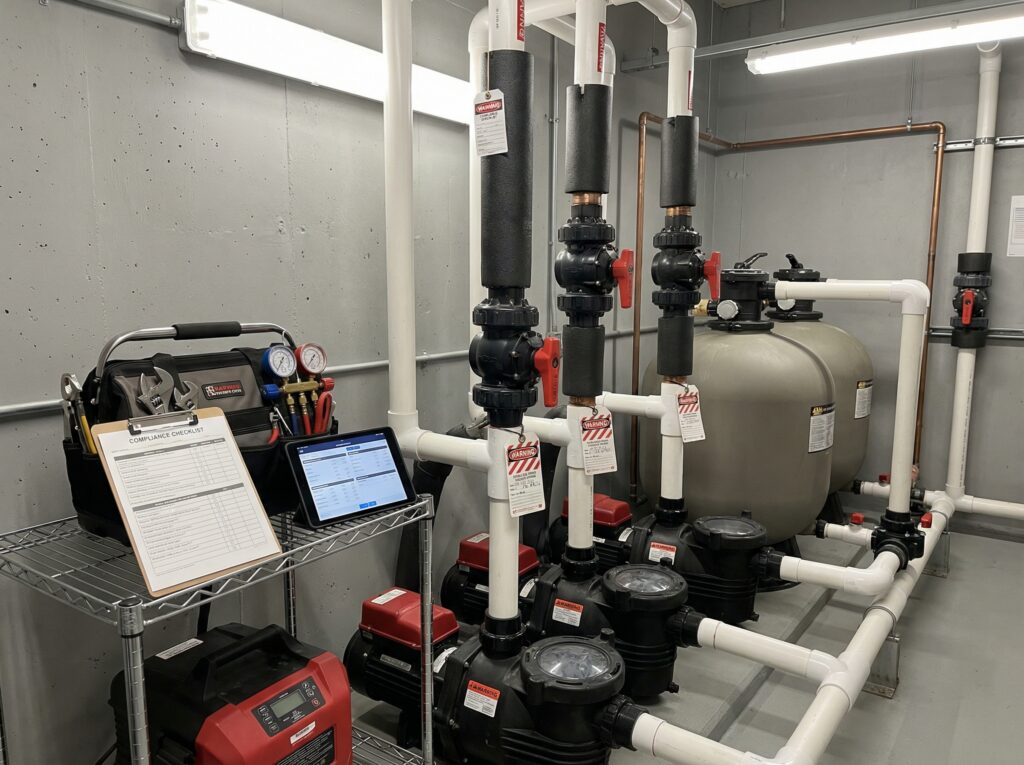
The circulation system moves water through filtration and treatment equipment, preventing stagnation and maintaining water quality. Key components include:
Pool Pump – The Heart of Your System:
- Your pool pump circulates 50,000-100,000 litres of water daily through filters, heaters, and treatment equipment. Modern pool pumps operate 8-12 hours daily, consuming 1,200-2,400 watts of electricity and representing the largest single component of pool operating costs.
- Variable-speed pumps deliver 50-75% electricity savings compared to traditional single-speed models, paying for themselves within 3-5 years through reduced power bills. Upfront investment ranges from $800-$1,500 installed, with eligibility for NSW energy efficiency rebates of $200-$400.
- Skimmers and Main Drains – Water Intake Points: Skimmers draw water from the pool surface where 70-80% of contamination floats (leaves, insects, pollen, oils). Main drains at the pool floor ensure complete circulation and prevent dead zones where algae establishes. Sydney pool owners should inspect and empty skimmer baskets 2-3 times weekly during swimming season to prevent flow restriction and pump strain.
- Return Jets – Delivering Clean Water: Return jets (typically 2-6 per pool) deliver filtered, heated, chemically-treated water back into your pool. Proper jet function ensures even chemical distribution and consistent water temperature. Loose or leaking jet fittings allow water to escape behind pool shell, causing structural damage costing $2,000-$8,000 to repair.
Filtration Systems
- Sand filters contain specially-graded silica sand that traps particles as water passes through. When pressure rises 8-10 PSI above clean baseline, backwashing becomes necessary. Sand replacement every 5-7 years costs $150-$300. Sand filters provide economical operation with minimal ongoing costs and 15-20 year equipment life.
- Cartridge filters use pleated fabric cartridges removing particles down to 10-15 microns for superior clarity. Monthly cartridge removal and hosing maintains performance, with cartridge replacement every 3-5 years costing $80-$200 per cartridge. No backwashing required provides water conservation benefits.
- DE (Diatomaceous Earth) filters provide the finest filtration available (3-5 microns) for exceptional water clarity. After backwashing, fresh DE powder must be added through the skimmer. Grid replacement every 5-10 years costs $400-$800. Highest maintenance requirements but superior results for those demanding crystal-clear water.
Heating Systems
- Gas heaters burn natural gas or LPG to heat water rapidly—capable of raising pool temperature 2-3°C per hour. Annual operating costs range from $800-$1,500 for natural gas or $1,200-$2,000 for LPG. Fast heating and reliable performance make gas heaters ideal for spas requiring high temperatures, but ongoing fuel costs and 10-15 year lifespan represent long-term expenses.
- Heat pump heaters extract ambient heat from air using 300-500% efficiency—every 1 kW of electricity produces 3-5 kW of heating. Annual operating costs of only $300-$600 make heat pumps the most economical option. Initial investment of $3,500-$6,000 (after NSW rebates) repays within 3-6 years through electricity savings. 15-20 year lifespan and quiet operation make heat pumps the modern standard for Sydney pools.
- Solar heating systems use roof-mounted collectors heating water with free solar energy. Initial investment of $4,000-$7,000 (after rebates) provides minimal ongoing costs of $50-$100 annually for pump operation. 15-25 year panel lifespan delivers the longest equipment life of any heating type. Sydney’s abundant sunshine makes solar heating highly effective from October through April.
Underground Plumbing Infrastructure
The underground plumbing network connecting pool equipment typically contains 50-100 meters of PVC pipes buried 300-600mm beneath ground level. Sydney’s reactive clay soils expand during wet periods and contract during drought, creating constant ground movement that cracks rigid PVC pipes. Tree roots aggressively seek moisture, infiltrating pipes through joints and cracks.
Professional leak detection using pressure testing and electronic equipment pinpoints leak locations within 30-60cm accuracy, enabling targeted excavation that minimizes landscape damage. Detection costs $200-$500 but prevents unnecessary excavation expenses of $2,000-$15,000.
NSW Pool Compliance Requirements: What Sydney Owners Must Know
Pool ownership in NSW comes with strict legal obligations protecting children, maintaining water quality, and ensuring environmental responsibility. Non-compliance results in fines, legal liability, insurance voidance, and delays in property transactions.
Mandatory Pool Registration
All NSW pools capable of holding more than 300mm of water must be registered on the Swimming Pool Register. This includes in-ground pools, above-ground pools with 300mm+ depth, spa pools, hot tubs, and portable pools exceeding 300mm depth.
Registration requirements include valid pool barrier certificate of compliance, current owner contact details, pool location and specifications, and compliance certificate updates every 3 years for non-shared pools or annually for shared/strata pools. Penalties for non-registration reach $5,500 plus potential liability if incidents occur.
Pool Barrier Compliance
NSW mandates minimum 1.2m fence height from finished ground level, maximum 10cm gap beneath barrier, self-latching gates opening outward with latches 1.5m+ from ground, and no climbable objects within 900mm of barrier. Non-compliant barriers result in council orders, fines, and insurance complications if accidents occur.
Water Quality and Chemical Handling
NSW health regulations require pool water meet specific safety standards: pH levels 7.2-7.8 (ideal 7.4-7.6), free chlorine 1.0-3.0 ppm, total alkalinity 80-120 ppm, and calcium hardness 200-400 ppm. Pools open to the public or shared facilities face stricter testing and documentation requirements with daily testing logs maintained for health department inspection.
Chemical storage compliance requires storing pool chemicals in cool, dry, well-ventilated areas, never mixing different chemical types, keeping chemicals in original containers with clear labeling, and locking storage areas accessible to children.
Backflow Prevention Testing
NSW legislation mandates annual testing of backflow prevention devices by licensed plumbers with appropriate certification. This prevents contamination of public water supply. Backflow devices must be tested annually by accredited testers, compliance certificates lodged with Sydney Water or local water authority, devices older than 10 years or failed units replaced, and testing records maintained for minimum 5 years. Failure to test backflow devices can result in water supply disconnection and substantial fines.
Common Pool & Spa Plumbing Problems: Symptoms & Solutions
Recognizing plumbing problems early prevents minor issues from escalating into expensive emergencies. These common problems affect Sydney pools, particularly after heavy summer use.
Mysterious Water Loss: Detecting & Fixing Leaks
- Water level drops of 10mm+ daily (beyond normal evaporation), constantly adding water to maintain levels, wet areas around pool equipment, unusually high water bills, and soft, spongy ground near pool indicate leak problems.
- Underground plumbing lines crack from Sydney’s reactive clay soils causing ground movement. Professional leak detection using pressure testing isolates specific leak locations, electronic equipment pinpoints underground breaks, dye testing identifies return line and skimmer leaks, and thermal imaging reveals temperature differences from leaking water.
- Pump and filter housing seals deteriorate from chemical exposure, UV radiation, and temperature cycling. DIY solutions include replacing pump lid O-rings annually ($10-$30 parts), lubricating seals with silicone-based lubricant, checking multiport valve for leaks during backwashing, and tightening union connections that have loosened over time.
- Return jets work loose from vibration, allowing water to seep behind pool shells. Warning signs include visible water seeping around jet housing, loose or wobbly jet fittings, cracked grout around jets, and soft areas in pool shell near returns. Simple gasket replacement costs $150-$300 while underground line repair costs $800-$2,500 and structural leak repair costs $2,000-$8,000+.
Annual pressure testing before summer identifies developing leaks before they cause expensive damage, costing $200-$350 but preventing thousands in emergency repairs.
Heating System Failures
- Gas heater issues include pilot light won’t stay lit from thermocouple failure or gas supply problems ($200-$400 repair), heater ignites then shuts off from pressure switch, flow switch, or temperature sensor faults ($300-$600), unusual noises or smells indicating burner scaling, gas leaks, or combustion problems requiring immediate professional attention, and reduced heating capacity from heat exchanger scaling due to improper water chemistry ($500-$1,200 descaling or replacement).
- Heat pump problems include unit runs but doesn’t heat from refrigerant leaks requiring licensed refrigeration technician ($600-$1,200), compressor won’t start from electrical faults, capacitor failure, or compressor failure ($400-$2,500), icing on evaporator coils from airflow restrictions or refrigerant issues ($300-$800), and error codes displayed requiring manufacturer documentation consultation.
- Solar heating issues include inconsistent heating from air locks in solar panels preventing circulation ($150-$300 bleeding service), panel leaks from UV degradation of rubber components ($400-$1,000 panel replacement per section), and circulation problems from valve failures or pump sizing issues ($200-$600).
Annual professional service costs $180-$350 for gas heaters (including burner cleaning, heat exchanger inspection, gas pressure testing), $200-$400 for heat pumps (refrigerant check, coil cleaning, electrical testing), and $150-$250 for solar systems (panel inspection, valve operation verification).
Equipment Malfunctions
Pool pumps require professional attention when exhibiting loud grinding, squealing, or unusual noises indicating bearing wear, motor overheating or shutting off on thermal protection, visible leaks from pump housing or unions, significantly reduced water flow despite clean baskets and filters, electrical issues tripping breakers or won’t start, excessive vibration, or age over 10-12 years.
Professional pump service costs $180-$350 while pump replacement including labor costs $600-$1,200. Variable-speed pump upgrades cost more initially ($800-$1,500) but save $200-$400 annually in electricity and qualify for NSW energy rebates.
Preventive Maintenance Schedule: Protecting Your Investment
Systematic maintenance prevents 70% of pool plumbing emergencies while extending equipment lifespan and reducing long-term costs.
Weekly Maintenance Tasks
- Water chemistry testing and adjustment 2-3 times weekly during swimming season includes testing pH, chlorine, and alkalinity using reliable test kits, adjusting chemicals to maintain ideal ranges, testing after heavy rain or high bather loads, and documenting readings to track trends.
- Visual equipment inspection involves checking pump basket for debris causing flow restrictions, verifying pressure gauge reading and noting baseline when clean, listening for unusual pump noises indicating bearing wear, inspecting visible plumbing for new leaks or moisture, and clearing skimmer baskets completely.
- Surface maintenance includes skimming debris from water surface, brushing walls and floor preventing algae establishment, and vacuuming pool weekly during swimming season.
Monthly Maintenance Checklist
- Equipment deep inspection includes removing and thoroughly cleaning pump basket and skimmer baskets, inspecting pump motor for leaks, corrosion, or overheating, checking all visible unions and connections for leaks, lubricating O-rings and seals with appropriate lubricant, testing pool heater operation and thermostat accuracy, and inspecting automatic pool cleaner for wear and proper operation.
- Filter maintenance varies by type: sand filters require backwashing when pressure increases 8-10 PSI above clean baseline, cartridge filters require removing and hosing down cartridges with deep cleaning quarterly, and DE filters require backwashing and adding fresh DE powder as per manufacturer specifications.
- Water balance testing beyond basic chemistry includes calcium hardness preventing equipment scaling and corrosion, cyanuric acid as stabilizer affecting chlorine efficiency, and total dissolved solids indicating when partial water replacement needed.
Seasonal Deep Maintenance
- Pre-summer preparation (September-October) includes professional equipment inspection and service, heating system testing and repair, acid wash or full pool cleaning if needed, equipment testing under load, salt cell cleaning for chlorinated pools, and replacing worn components before failures occur.
- Post-summer assessment (March-April) after intensive use includes comprehensive leak detection and pressure testing, equipment performance evaluation, identifying components approaching end-of-life, planning repairs before next season, and considering winterization or reduced-operation mode.
- Pre-winter winterization (May-June) includes balancing water chemistry for winter, lowering water levels if recommended for your pool type, adding winterizing chemicals preventing algae, cleaning and storing removable equipment, protecting exposed plumbing from rare freezing events, reducing pump operation hours, and covering pool if appropriate for your design.
Pool Winterization: Sydney’s Unique Requirements
Unlike colder climates requiring complete pool closure, Sydney’s mild winters allow modified operation with reduced maintenance and costs.
Should You Winterize Your Sydney Pool?
Full winterization (draining and closing) is rarely necessary in Sydney’s climate, only recommended for pools unused for 6+ months, risks structural damage from ground pressure on empty shell, and increases maintenance costs re-starting pool in spring.
Recommended approach involves reduced operation: maintain circulation at reduced hours (3-4 hours daily), continue basic chemical maintenance, cover pool to reduce debris and heat loss, reduce heating or turn off completely, and monitor weekly rather than daily.
Cost comparison shows full winterization costs $300-$600 plus $400-$800 spring re-start, while reduced operation winter costs only $50-$100 monthly running costs. Most Sydney pool owners choose reduced operation, saving money while maintaining pool health.
Step-by-Step Winterization Process
- 4-6 weeks before winter (March-April) involves deep cleaning pool completely by vacuuming thoroughly, brushing walls and floor, removing all debris, and cleaning tiles and waterline. Professional equipment inspection addresses any repairs before winter, replaces worn components, tests all systems under load, and documents equipment condition. Balancing water chemistry perfectly requires pH 7.4-7.6, alkalinity 100-120 ppm, calcium 200-300 ppm, and chlorine 2-3 ppm.
- Early winter (May-June) involves reducing pump operating hours from 8-10 hours daily to 3-4 hours, running during warmest part of day while maintaining adequate circulation preventing stagnation. Applying winterizing treatments includes long-life algaecide lasting 2-3 months, phosphate remover reducing algae nutrients, and maintaining chlorine with slow-release tablets. Installing pool cover if applicable reduces debris accumulation, minimizes heat loss, reduces chemical consumption, and must allow drainage—never completely seal pool.
- Throughout winter (June-August) requires weekly monitoring with visual check for debris and water clarity, monthly chemical testing and adjustment, removing accumulated leaves and debris, and checking equipment operation weekly. Maintaining minimum circulation means never completely shutting down system for extended periods, as stagnant water creates algae blooms and equipment problems while maintaining light chlorination.
When to Call Licensed Pool Plumbers: DIY vs Professional
Understanding which pool maintenance tasks are DIY-friendly and which require licensed professionals protects your safety, equipment warranty, and insurance coverage.
DIY-Appropriate Tasks
Homeowners can safely perform weekly water testing and chemical adjustment, skimmer and pump basket cleaning, pool surface cleaning including skimming, brushing, and vacuuming, filter pressure monitoring, visual equipment inspections, and basic troubleshooting such as checking power and resetting breakers.
DIY limitations exist because even simple tasks become dangerous when dealing with electrical components near water, gas systems, or underground plumbing. Never attempt repairs beyond your skill level.
Professional-Only Pool Services
- Licensed plumbers are required for gas fitting work including all gas heater installation, repairs, or modifications, gas line testing and leak detection, pressure regulator adjustments, and burner cleaning and calibration.
- Electrical work requires pool pump motor replacement or repairs, electrical control systems, lighting installations or repairs, and safety switch testing and replacement.
- Plumbing repairs require underground pipe repairs or replacements, heating system plumbing modifications, equipment plumbing connections, and backflow prevention device testing legally required annually.
- Leak detection requires pressure testing pool systems, electronic leak detection equipment, structural leak assessment, and underground line tracing.
Why Professional Service Matters
Legal compliance requires NSW mandates licensed tradespeople for gas and electrical work. Safety concerns arise because pool equipment combines water, electricity, and sometimes gas—lethal if improperly serviced. Insurance validity depends on proper installation as DIY repairs void equipment warranties and insurance coverage. Code compliance ensures professional work meets Australian Standards. Diagnostic accuracy means professionals identify root causes, not just symptoms.
Emergency situations requiring immediate professional help include gas smells near pool equipment, electrical faults, sparks, or shocks, major leaks flooding yards or equipment areas, equipment making loud unusual noises, complete circulation system failure, and heating system lockouts or errors.
Cost-Saving Strategies: Smart Pool Maintenance Budgeting
Pool ownership costs Sydney households $1,200-$3,000 annually including chemicals, electricity, maintenance, and repairs. Strategic planning reduces these expenses without compromising water quality or equipment health.
Annual Pool Operating Cost Breakdown
Typical Sydney residential pool (40,000-50,000L) costs include chemicals at $300-$600 annually (chlorine/salt $150-$250, pH adjusters $50-$100, algaecides and specialty chemicals $100-$250), electricity at $400-$800 annually (pool pump operation $250-$500, heating if used $300-$1,500 additional, automation and lighting $50-$100), water at $100-$300 annually (evaporation replacement, backwashing/cleaning, leak compensation if present), and professional maintenance at $200-$600 annually (equipment servicing, opening/closing services, repairs and parts). Total ranges from $1,000-$2,800 without major repairs.
10 Proven Cost-Reduction Strategies
1. Invest in variable-speed pumps reducing electricity consumption by 50-75% compared to single-speed models. Upfront cost of $800-$1,500 installed delivers annual savings of $200-$400 in electricity with payback period of 3-5 years. Additional benefits include quieter operation and longer equipment life.
2. Install solar pool heating with Sydney’s abundant sunshine making solar heating economically attractive. Upfront cost of $3,000-$6,000 installed delivers annual savings of $500-$1,200 vs gas heating with payback period of 3-6 years and lifespan of 15-20 years.
3. Use pool covers reducing evaporation by 90-95%, cutting water and chemical costs. Cost of $500-$2,000 depending on type delivers annual savings of $200-$500 with additional benefits of reducing debris, retaining heat, and improving safety.
4. Optimize pump run times by running pumps during off-peak electricity periods and only as long as necessary. Minimum circulation of 8 hours daily in summer and 4 hours in winter with off-peak operation provides 50% electricity cost reduction with time-of-use tariffs.
5. Maintain proper water chemistry with balanced water preventing equipment corrosion and reducing chemical consumption. Testing weekly prevents costly corrections, small adjustments are more effective than large chemical dumps, and quality test kits costing $50-$100 save hundreds in wasted chemicals.
6. Address leaks promptly as even small leaks waste thousands of litres and increase chemical costs. Annual leak testing costs $150-$300, early repair costs $300-$800, while delayed repair costs $2,000-$8,000 plus ongoing waste.
7. Clean filters regularly as dirty filters force pumps to work harder, increasing electricity costs and equipment wear. Time investment of 15-30 minutes monthly delivers energy savings of 10-20% pump efficiency improvement and extends pump life 2-3 years.
8. Winterize appropriately by reducing operating costs during low-use periods without full closure. Reduced circulation provides 50% electricity savings, minimal chemicals cost $20-30 monthly vs $50-100, with winter savings of $300-$500 over winter period.
9. Schedule preventive maintenance with annual professional servicing costing $200-$400 preventing $2,000-$5,000 emergency repairs and extending equipment life 3-5 additional years.
10. Group repairs and services by scheduling multiple maintenance tasks simultaneously reducing call-out fees. Strategy of annual comprehensive service addressing all minor issues provides savings of $100-$200 in reduced call-out fees with efficiency of single day of disruption vs multiple appointments.
Frequently Asked Questions: Pool & Spa Plumbing Sydney
How often should pool plumbing be professionally inspected?
Professional pool plumbing inspection should occur annually, ideally before summer swimming season begins (September-October). Annual inspections identify developing issues before they cause equipment failures or expensive emergency repairs. Properties with older equipment (10+ years), pools experiencing recurring problems, or pools with known leaks benefit from bi-annual inspections. Professional inspection costs $180-$350 and typically includes pressure testing, equipment performance assessment, leak detection, heating system evaluation, and detailed reporting with repair recommendations.
What causes pool water levels to drop excessively?
Water loss beyond normal evaporation (5-10mm daily in Sydney summer) indicates leaks requiring professional investigation. Common leak sources include underground plumbing line cracks from ground movement, pump and filter housing seal failures, return jet fitting failures allowing water behind pool shell, skimmer seal deterioration, and structural cracks in pool shell. Professional leak detection using pressure testing, electronic detection equipment, and dye testing pinpoints exact leak locations. Ignoring leaks wastes thousands of litres, increases water bills, and can cause structural damage costing thousands to repair.
How much does pool heating system repair cost in Sydney?
Pool heating repair costs vary by system type and problem severity. Gas heater repairs typically cost $300-$800 for component replacements (thermocouples, pressure switches, ignition systems) and $800-$2,500 for heat exchanger replacement. Heat pump repairs range from $400-$1,200 for compressor issues, electrical faults, or refrigerant leaks. Solar heating repairs cost $200-$600 for valve replacements and circulation problems, $400-$1,000 for panel replacements. Emergency after-hours service adds 50-100% to standard rates. Annual preventive maintenance ($180-$350) prevents most emergency repairs and extends equipment life significantly.
Should I winterize my pool in Sydney?
Sydney’s mild winters rarely require complete pool winterization. Most Sydney pool owners choose reduced-operation mode rather than full closure: continue circulation at reduced hours (3-4 hours daily vs 8-10), maintain basic chemical balance, use pool covers to reduce debris and heat loss, turn off heating systems, and monitor weekly rather than daily. Full winterization (draining and closing) risks structural damage and costs $300-$600 plus $400-$800 spring reopening. Reduced-operation mode costs $50-$100 monthly while maintaining pool health. Only pools unused for 6+ months benefit from complete winterization.
What qualifications should pool plumbers have in NSW?
Pool plumbers in NSW require specific licenses and qualifications: licensed plumber contractor license for all plumbing work, gas fitting license for pool heater installation and repairs (legally required for all gas work), electrical contracting license for pump motors and electrical systems, backflow prevention testing accreditation (required for annual testing), refrigeration license for heat pump refrigerant work, and comprehensive public liability insurance ($20 million minimum). Always verify licensing with NSW Fair Trading before engaging services. Unlicensed pool work voids equipment warranties, insurance coverage, and creates safety hazards. Licensed professionals provide compliance certificates required for insurance claims and property sales.
How do I detect pool plumbing leaks?
Detecting pool leaks requires systematic testing. Start with the bucket test: fill bucket with pool water, place on pool step with water levels equal inside and outside, mark both levels, wait 24 hours, and compare water loss (equal loss equals evaporation, pool loses more equals leak). For underground leaks, professional pressure testing isolates specific pipe sections. Electronic leak detection equipment pinpoints exact leak locations. Dye testing around suspected areas (skimmers, returns, fittings) reveals directional water movement. Thermal imaging identifies temperature differences from leaking water. Professional leak detection costs $200-$400 but saves thousands by pinpointing repairs rather than exploratory excavation.
What are signs my pool pump needs professional service or replacement?
Pool pumps require professional attention when exhibiting loud grinding, squealing, or unusual noises indicating bearing wear, motor overheating or shutting off on thermal protection, visible leaks from pump housing or unions, significantly reduced water flow despite clean baskets and filters, electrical issues (trips breakers, won’t start), excessive vibration, or age over 10-12 years. Don’t delay pump service—complete failures during swimming season mean pool unusability until repairs complete. Professional pump service costs $180-$350. Pump replacement including labor costs $600-$1,200. Variable-speed pump upgrades cost more initially ($800-$1,500) but save $200-$400 annually in electricity and qualify for NSW energy rebates.
Protect Your Pool Investment: Take Action Today
Swimming pool and spa plumbing maintenance isn’t optional—it’s essential protection for your substantial property investment. After this summer’s intensive use, your pool’s plumbing and equipment have been tested to their limits. The transition into autumn provides the perfect opportunity to assess wear, address developing problems, and implement preventive maintenance preventing costly winter failures.
The pool owners who will face expensive emergency repairs, equipment failures, and frustrated guests are those reading this guide and thinking “I’ll deal with it later.” Don’t become that emergency callout statistic. Proactive maintenance costs a fraction of reactive repairs while ensuring your pool remains safe, compliant, and ready for year-round enjoyment.
Whether you need comprehensive annual inspection, leak detection, heating system service, or emergency repairs, professional pool plumbing services protect your investment and provide genuine peace of mind.
Why Choose AIM LOCAL for Pool & Spa Plumbing Services
AIM LOCAL delivers specialized pool and spa plumbing expertise across Sydney, Central Coast, and Newcastle with:
✓ Licensed professionals with extensive pool plumbing experience
✓ Comprehensive services including leak detection, heating repairs, equipment installation, and preventive maintenance
✓ 24/7 emergency response for urgent pool plumbing failures
✓ Transparent pricing with upfront quotes and no hidden costs
✓ Compliance expertise ensuring all work meets NSW requirements
✓ Multi-trade capability handling plumbing, electrical, and gas work
✓ Quality parts and warranties on all installations and repairs
Don’t wait for pool plumbing failures to disrupt your lifestyle and drain your budget. Contact AIM LOCAL today for comprehensive pool inspection, professional maintenance, or emergency repairs.
Call AIM LOCAL: 1800 187 168 (24/7)
Available across Sydney, Central Coast & Newcastle
Your pool deserves professional care—and your family deserves the safety, comfort, and reliability that expert pool plumbing maintenance delivers.