
What to Expect When You Call an Emergency Electrician in Hornsby
When you need an emergency electrician in Hornsby, every minute counts. Whether you’ve lost power to half the house, tripped a breaker that won’t reset, or spotted sparking wires, knowing what to expect — response times, costs, and the right steps to take — can make a stressful situation manageable. This guide covers everything Hornsby and North Shore homeowners need to know about emergency electrical services.
Table of Contents
- What Counts as an Electrical Emergency?
- Average Response Times in Hornsby and the North Shore
- Cost Ranges: After-Hours vs Standard Call-Outs
- What to Do Before the Electrician Arrives
- Why Using a Local Hornsby Electrician Matters
- Frequently Asked Questions
What Counts as an Electrical Emergency?
Not every electrical problem is a true emergency — but misjudging one can be dangerous or costly. Here’s how to tell the difference between situations that need immediate attention and those that can wait until business hours.
Genuine Emergencies — Call Now
- Sparking or arcing wires — visible sparks from an outlet, switchboard, or appliance indicate a serious fault that can ignite a fire within seconds.
- Burning smell without a visible source — this often means wiring insulation is overheating inside your walls.
- Complete power loss — if your neighbours have power but you don’t, a fault on your property (not just a grid outage) needs urgent investigation.
- Tripped circuit breaker that won’t reset — a breaker that trips repeatedly signals an overloaded or faulty circuit that shouldn’t be ignored.
- Water near electrical fittings — flooding, roof leaks, or burst pipes in proximity to your switchboard or outlets create an electrocution risk.
- Buzzing or humming from the switchboard — unusual sounds from your switchboard can indicate a loose connection or failing component.
- Smoke from an outlet or appliance — shut off the circuit immediately and call an emergency electrician in Hornsby without delay.
Urgent But Not Emergency — Same-Day or Next-Morning Service
- Single outlet that stopped working (no smell, no sparks)
- Flickering lights in one room
- Hot water system not functioning (check the hot water system’s dedicated circuit)
- Outdoor lighting fault
If you’re unsure, err on the side of caution. AIM LOCAL’s emergency electrical services team is available 24/7 to assess your situation over the phone before dispatching — so you don’t pay after-hours rates for something that can safely wait.
Average Response Times in Hornsby and the North Shore
Response time is one of the biggest differences between using a local Hornsby electrician versus a company based in the CBD or outer suburbs. Here’s what you can realistically expect across the North Shore.
| Area | Typical After-Hours Response | Notes |
|---|---|---|
| Hornsby / Asquith | 30–60 minutes | Local depot; priority zone |
| Waitara / Normanhurst | 30–60 minutes | Adjacent suburbs; fast response |
| Thornleigh / Pennant Hills | 45–75 minutes | 15–20 min drive from Hornsby |
| Mount Colah / Berowra | 60–90 minutes | Northern end of the line |
| Gordon / Turramurra | 45–75 minutes | Southern North Shore coverage |
| Epping / Eastwood | 60–90 minutes | Traffic-dependent |
These times assume typical overnight or weekend conditions with minimal traffic. During peak-hour emergencies, add 15–30 minutes for suburbs further from Hornsby. Companies dispatching from Parramatta, the Hills, or the CBD will often quote 90 minutes or more for a Hornsby job.
What Affects Response Time
- Crew availability — local operators with Hornsby-based crews beat city-based companies every time on response.
- Time of day — 11 pm on a weeknight is faster than 7 am on a Monday morning (when crews are dispatching to pre-booked jobs).
- Weather events — storm damage creates high demand across all trades simultaneously; book early if storms are forecast.
- Job complexity — a safe-off-power situation may be responded to faster than a live-fault diagnostics job requiring specialised equipment.
Cost Ranges: After-Hours vs Standard Call-Outs
Understanding electrical emergency costs before the invoice arrives saves unnecessary surprise. The key cost drivers are the callout fee, labour rate, and parts — and all three increase after hours.
Sydney Electrician Service Fee Structure
The callout fee covers dispatch and arrival — labour is quoted separately before any work begins.
| When You Call | Typical Service Fee (Sydney / Central Coast) |
|---|---|
| Mon–Fri, 7:30 am–4 pm | $60–$100 (standard hours) |
| Weekdays after 4 pm | $150–$300 (after-hours) |
| Saturday | $150–$250 (weekend rate) |
| Sunday / Public Holiday | $200–$350 (public holiday rate) |
Service fees vary between providers. Always confirm the callout fee before booking.
What the Service Fee Covers — and What It Doesn’t
The service fee is your call-out cost — it covers getting a licensed electrician to your door. It does not include labour for the repair itself, parts, or any materials. Before any work begins, you’ll receive a clear quote for the full job. This means no surprise invoices.
For context: a simple job like resetting a tripped circuit or testing a faulty outlet during business hours starts from $65 — the standard Sydney callout fee plus a short labour component. The same job called at 9 pm on a Tuesday starts from $180–$320. If you’re unsure whether your situation can wait until morning — call and describe it. AIM LOCAL can advise over the phone before charging a callout.
Always request a written quote before work begins — a licensed electrician is legally required to provide one for any job over $1,000.
What Gets Added to the Bill
- Parts and materials — standard components (breakers, outlets, conduit) are typically marked up 15–30% above trade price
- Safety certificates — a Certificate of Compliance for Electrical Work (CCEW) is required for most licensed work in NSW and is included or charged separately at $30–$80
- Travel time — some operators charge from depot; others charge from when they arrive. Clarify before booking
AIM LOCAL provides upfront pricing before any work starts. There are no surprise line items on your invoice. For electrical safety inspections or switchboard upgrades discovered during an emergency call, you’ll receive a separate quote before any additional work proceeds.
What to Do Before the Electrician Arrives
The steps you take in the first few minutes after an electrical fault can prevent injury, reduce damage, and make the electrician’s job easier. Here’s a practical sequence to follow.
Step 1: Don’t Touch Anything That May Be Live
This sounds obvious but is ignored in the panic of the moment. If you can see sparks, smell burning, or hear buzzing from an outlet or appliance — do not touch it. Use a wooden or rubber-handled object to move obstructions if needed, but keep your hands away from anything electrical.
Step 2: Locate Your Switchboard and Turn Off the Affected Circuit
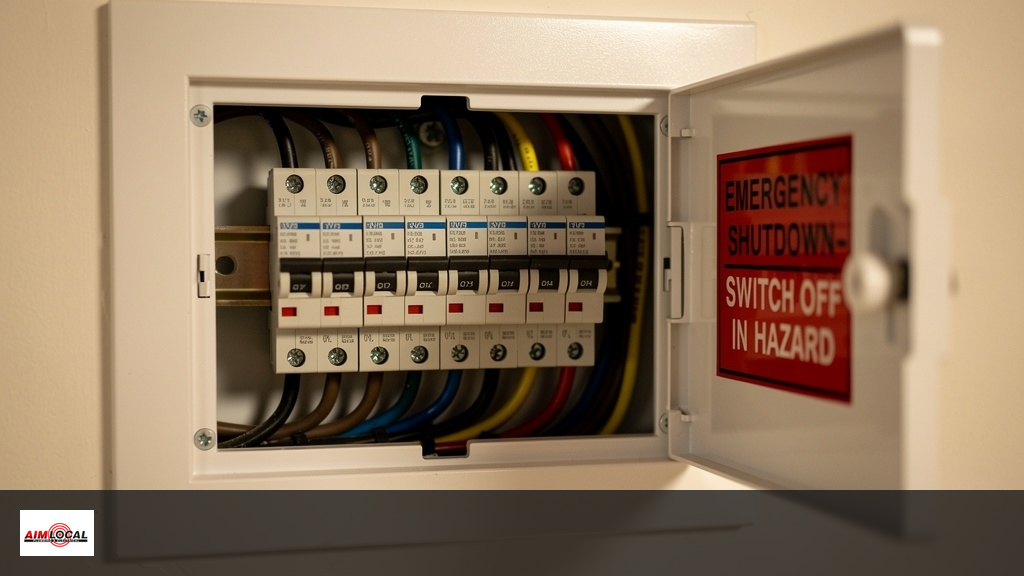
Your switchboard is usually in a hallway cupboard, garage wall, or laundry. If you can safely access it, flip the circuit breaker for the affected area to the OFF position. If you don’t know which circuit is affected, or if the switchboard itself is sparking or warm, do not open the panel — call immediately and describe the situation.
Step 3: Turn Off and Unplug Appliances
Once the circuit is off, unplug appliances from outlets on that circuit. This reduces load when power is restored and helps the electrician isolate the fault source.
Step 4: Clear the Area
Keep children and pets away from the affected area. If there’s any sign of smoke, evacuate and call 000 before calling an electrician — fire services take priority.
Step 5: Document What Happened
Take a photo or note down what you were doing when the fault occurred, which appliances were on, and whether there were any storms, power fluctuations, or unusual smells beforehand. This information speeds up diagnosis significantly.
Step 6: Gather Your Property Details
When you call, have ready: your full address including suburb, a description of the fault, whether you have single or three-phase power (most homes are single phase), and whether the switchboard is inside or outside. This helps the dispatcher assess urgency and send the right crew.
If you’re concerned about an existing electrical issue but not sure it’s an emergency, AIM LOCAL offers electrical maintenance services and circuit troubleshooting at standard rates during business hours.
Why Using a Local Hornsby Electrician Matters
When you search for an emergency electrician at 11 pm, you’ll find national directory listings, franchise chains, and companies operating from depots 30+ km away. Here’s why booking a Hornsby-based licensed electrician makes a real difference.
Faster Arrival Times
A Hornsby electrician is typically 30–60 minutes away from any North Shore address. A company based in Parramatta or the Inner West adds 45–90 minutes to that — at after-hours rates, that travel cost comes straight out of your pocket.
Knowledge of Local Infrastructure
Electrical contractors who regularly service Hornsby, Asquith, Waitara, and Normanhurst understand the local housing stock. Federation and post-war homes in the North Shore often have older wiring configurations, unprotected circuits, and switchboards that predate modern safety standards. A local electrician has seen these patterns before and diagnoses faster.
Accountability and Reputation
A local business lives or dies by word of mouth in the community. An electrician who services Hornsby customers regularly can’t afford to quote-and-run or do substandard work. You have recourse — through local reviews, the Master Electricians Association, and NSW Fair Trading — that is harder to exercise with a remote operator.
Licensed and Insured — Every Time
In NSW, all electrical work must be performed by a licensed electrician. You can verify any licence at NSW Fair Trading’s licence check. AIM LOCAL electricians hold current NSW electrical contractor licences and carry full public liability insurance on every job.
Hornsby and North Shore Service Areas
AIM LOCAL covers the full North Shore corridor including Hornsby, Asquith, Waitara, Normanhurst, Thornleigh, Pennant Hills, and surrounding suburbs. For a full list of service locations, visit the Electrical locations page.
Get professional advice today by visiting AIM LOCAL Contact Us.
Need an Emergency Electrician in Hornsby Right Now?
AIM LOCAL’s licensed electricians are available 24/7 across Hornsby, the North Shore, and surrounding suburbs. Upfront pricing, fast response, fully insured.
Get Your Free QuoteFrequently Asked Questions
Q: How quickly can an emergency electrician reach Hornsby?
A: AIM LOCAL’s Hornsby-area electricians typically arrive within 30–60 minutes for after-hours callouts. Response time depends on crew availability and traffic, but local dispatch means we’re usually on-site faster than city-based operators.
Q: How much does an after-hours electrician cost in Hornsby?
A: most Sydney tradespeople charge $180–$320 for weekday evenings (after 4 pm) and Sundays/public holidays, and $180–$320 on Saturdays. This covers the callout — labour for the repair is quoted separately before any work begins. During business hours (Mon–Fri, 7:30 am–4 pm), standard Sydney rates drop to $65 during business hours.
Q: What should I do if my switchboard is sparking?
A: Do not open the switchboard panel. Keep everyone away from the area, turn off your main switch at the meter box if it’s safe to do so, and call an emergency electrician immediately. If there’s smoke or fire, call 000 first.
Q: Is a tripped circuit breaker an emergency?
A: A single trip that resets and holds is usually not an emergency — reset it and monitor. If the breaker trips again immediately, if it trips multiple circuits, or if the panel feels warm, treat it as urgent and call a licensed electrician. Repeated tripping indicates a fault that can escalate.
Q: Do I need a Certificate of Compliance after emergency electrical work in NSW?
A: Yes. Any licensed electrical work in NSW requires a Certificate of Compliance for Electrical Work (CCEW) to be issued by the contractor. This is your legal record of the work done and is required for insurance claims and property sales. Ensure you receive this after any emergency repair.
Q: Can I reset my own circuit breaker?
A: Resetting a tripped breaker (flipping it fully off, then back on) is safe for a homeowner to do. However, if the breaker trips again, do not keep resetting it — there is a fault on the circuit that needs a licensed electrician to diagnose and fix.
Q: How do I verify an electrician’s licence in NSW?
A: Go to the NSW Fair Trading licence check at fairtrading.nsw.gov.au and search by licence number or business name. A valid NSW electrical contractor licence (EC licence) is required for any residential or commercial electrical work. AIM LOCAL’s licence details are available on request.