
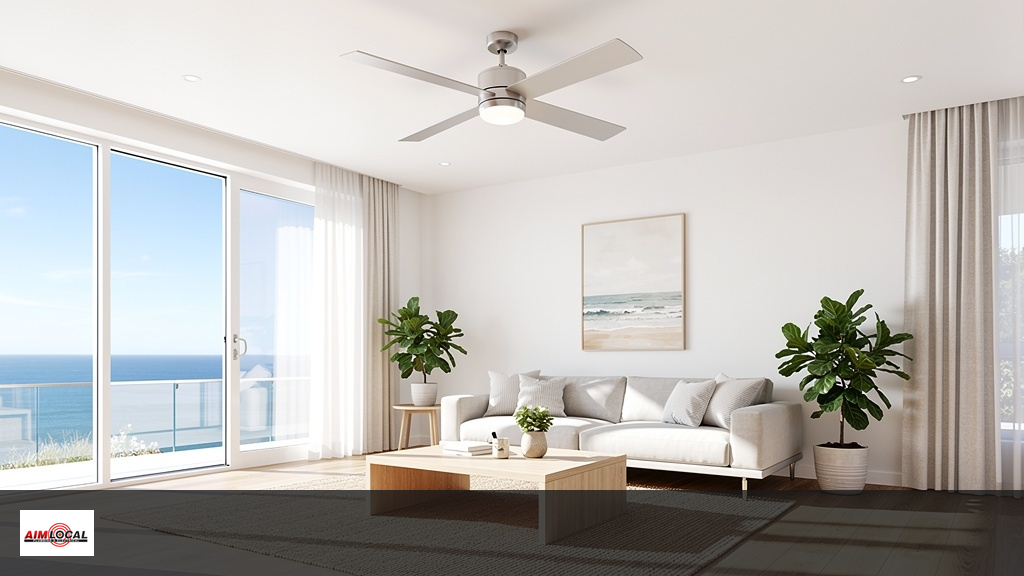
Ceiling fan installation on the Central Coast sounds simple — but pick the wrong model for the coastal humidity, skip the rated brace box, or hire an unlicensed electrician, and you’ll be dealing with a wobbly fan, a rejected insurance claim, or a repeat job within two years. This guide covers real costs for Central Coast installations, the best brands for coastal conditions, and exactly what a licensed electrician should do.
Table of Contents
- Ceiling Fan Installation Costs on the Central Coast
- Best Ceiling Fan Brands for Coastal NSW Conditions
- Types of Ceiling Fans — Which Suits Your Home?
- What Happens During a Professional Installation
- NSW Licensing Laws — Why DIY Is Off the Table
- Tips for Getting the Most from Your Ceiling Fan
- Frequently Asked Questions
Ceiling Fan Installation Costs on the Central Coast
Ceiling fan installation central coast typically costs between $80 and $450 per fan, depending on whether existing wiring is in place and how complex the job is. The Central Coast market sits broadly in line with Sydney pricing, though some tradespeople factor in travel time for outer suburbs like Doyalson, Wyong, or Somersby.
Cost Breakdown by Installation Type
| Installation Scenario | Typical Cost (Central Coast) | Notes |
|---|---|---|
| Replace existing fan, same wiring | $80–$150 | 30–45 min job |
| New fan on existing light circuit | $120–$200 | Circuit load check required |
| New fan with new wiring run | $250–$450 | Ceiling access needed |
| Fan with remote control module | $150–$280 | Add $50–$120 for receiver kit |
| Fan + integrated LED light kit | $180–$350 | Varies by fan model |
| Multiple fans, same visit (3+) | $80–$120 per fan | Callout fee shared |
Most licensed tradespeople on the Central Coast charge $60–$100 during business hours. After-hours and weekend rates typically run $150–$300. Service fees vary between providers — always confirm the callout fee before booking.
What Affects the Final Price on the Central Coast
- Existing wiring condition: Many older Central Coast homes — particularly around Gosford, Wyoming, and Terrigal — have two-wire circuits without an earth. Modern fans require an earth connection, which may mean additional wiring work
- Ceiling height and type: Raked or high ceilings common in Avoca Beach, Erina, and Wamberal hinterland homes need extension rods and take longer to rig safely
- Fan weight: Any fan over 3.5 kg requires a rated brace box — if one isn’t already installed, your electrician will supply and fit it
- Outdoor or semi-outdoor location: Alfresco areas, verandahs, and covered pergolas require IP-rated fans — expect to pay 20–30% more for the appropriate model
- Multiple fans: Booking 3–4 fans in one visit brings the per-fan cost down significantly
Best Ceiling Fan Brands for Coastal NSW Conditions
The Central Coast has a genuinely coastal climate — salt air, high humidity from October through April, and warm evenings that make fans a necessity rather than a luxury. Not all ceiling fans handle this environment equally well.
Top Brands Suited to Central Coast Homes
| Brand | Price Range (fan only) | DC Motor? | Coastal Suitability |
|---|---|---|---|
| Hunter Pacific | $150–$800 | Yes (most models) | Excellent — designed for Australian climate |
| Martec | $120–$650 | Yes | Excellent — quiet, salt-air resistant finishes |
| Fanco | $200–$900 | Yes | Very good — premium DC, long warranty |
| Mercator | $100–$500 | Yes (Ikuu) | Good — smart-home compatible, good value |
| Brilliant Lighting | $130–$600 | Yes | Good — integrated lighting, modern profiles |
For outdoor or alfresco installations anywhere near the coast — Terrigal, Avoca, Wamberal, Copacabana — look specifically for IP44 or IP55 rated fans. Standard indoor fans will corrode and fail within 12–18 months in salt-air environments, regardless of brand.
DC vs AC Motor — Which Should You Choose?
DC motors use up to 70% less energy than AC motors, run quieter, and typically carry a longer warranty. For a Central Coast home where fans run 8–9 months of the year, a DC motor fan pays for itself within 2–3 seasons through reduced electricity bills. AC motors are still reliable for occasional-use rooms — garages, laundries, rarely-used guest rooms. According to the Australian Energy website, ceiling fans are among the most energy-efficient cooling options available, costing roughly 1–2 cents per hour to run.
Types of Ceiling Fans — Which Suits Your Home?
Standard Ceiling Fans
Most common in Central Coast homes. Typically 900–1200mm blade span, suitable for rooms up to 20 sqm. Available with or without integrated lighting. Best for: bedrooms, living rooms, dining rooms in standard-height homes.
Low-Profile (Hugger) Fans
Designed for ceilings below 2.4m. The motor housing mounts close to the ceiling with no drop rod. Less airflow efficiency than standard fans, but the safest option for low-clearance rooms. Best for: older units and apartments in Gosford, Wyong, Toukley, and Budgewoi.
Outdoor-Rated Fans
IP-rated (typically IP44 or IP55) to handle moisture, salt air, and coastal humidity. Essential for covered alfresco areas, pergolas, and verandahs on the Central Coast. A standard indoor fan will corrode within 12–18 months if installed outdoors near the coast. Don’t cut corners on this — the repair cost will exceed the price difference.
Smart / App-Controlled Fans
Compatible with Google Home, Amazon Alexa, or Apple HomeKit. Control speed, light, and direction from your phone. The Mercator Ikuu range and Brilliant Smart series are popular on the Central Coast. Requires a wireless receiver module wired in by your electrician during installation.
What Happens During a Professional Installation
A proper ceiling fan installation by a licensed electrician covers more than hanging the fan. Here’s the full sequence:
- Isolation: The circuit is isolated at the switchboard and confirmed de-energised with a voltage tester before any work begins
- Mounting check: The existing ceiling rose or bracket is inspected. Fans over 3.5 kg require a rated fan brace box — your electrician will install one if it’s not already there
- Wiring check: Pre-1990 homes (common in older Central Coast suburbs) may have two-wire circuits. Your electrician identifies this and advises on options — most modern fans need an earth
- Assembly: Blades, motor housing, and light kit are assembled on the ground first — this avoids repeated trips up the ladder
- Hanging and balancing: The fan is connected and run at all speed settings to check for wobble. Balancing clips are added if needed
- Control configuration: Remote receivers are programmed, wall controls tested on all speeds, reverse mode confirmed
- Clean up: Work area tidied, packaging removed
The whole job typically takes 30–60 minutes per fan for a simple replacement, or 1–2 hours per point when new wiring is required. Our team also handles switchboard upgrades and electrical safety inspections across the Central Coast — if you’re already booking an electrician, it’s worth combining the jobs to maximise the callout.
The Brace Box — Why It Matters
Every fan over 3.5 kg must be hung from a rated brace box or fan-rated ceiling rose — not a standard light fitting. A standard fitting carries 2–3 kg of static load. A ceiling fan creates dynamic load through vibration and centrifugal force that will eventually pull a standard fitting out of the ceiling. If your existing fitting isn’t rated, your electrician replaces it before installing the fan. This isn’t optional.
NSW Licensing Laws — Why DIY Is Off the Table
In NSW, all electrical wiring work — including ceiling fan installation — must be carried out by a licensed electrician. NSW Fair Trading is clear on this: connecting a fan to your home’s wiring is licensed electrical work under the Electricity (Consumer Safety) Act.
What DIY Actually Costs You
- Insurance: A home insurance claim after an electrical fire may be denied if unlicensed work is present
- Safety: Incorrect earthing, overloaded circuits, and poor mechanical mounting cause fires and injury
- Resale: A building inspection will flag unlicensed electrical work. You’ll remediate before settlement or accept a reduced price
- Fines: NSW Fair Trading can issue fines of up to $22,000 for unlicensed electrical work
The cost of a licensed installation is $80–$250. The cost of getting it wrong is considerably higher. If you’ve recently had a hot water system upgrade, a ceiling fan installation is a natural next step for improving home comfort — bundle them with your plumbing and electrical team in one visit.
Tips for Getting the Most from Your Ceiling Fan
Use Reverse Mode in Winter
All modern ceiling fans have a reverse button. In winter, run the fan on its lowest speed in reverse — this pushes warm air that has collected at the ceiling back down into the room without creating a wind-chill effect. Studies suggest this can reduce heating costs by 10–15% in open-plan spaces.
Match Blade Span to Room Size
| Room Size | Recommended Blade Span |
|---|---|
| Up to 10 sqm | 900–1050mm |
| 10–20 sqm | 1050–1200mm |
| 20–35 sqm | 1200–1400mm |
| 35 sqm+ | 1400–2000mm or two fans |
Book Multiple Fans at Once
Electricians charge a fixed callout regardless of how many fans they install. Booking three or four fans in one visit dramatically reduces the per-fan cost and gets your whole home sorted in a single visit. If you’re also looking at other electrical services on the Central Coast, our team covers plumbing, electrical, and roofing across Gosford, Wyong, Terrigal, Erina, Tuggerah, The Entrance, and all surrounding suburbs.
Check Your Switchboard First
Older Central Coast homes with ceramic fuse-based switchboards may not safely support additional fan circuits. If your switchboard has fuses rather than circuit breakers, it’s worth having it inspected at the same time as your fan installation. Our hot water and electrical team can assess both in a single visit.
Ready to Install Your Ceiling Fan on the Central Coast?
Licensed electricians, same-week availability across Gosford, Wyong, Terrigal, The Entrance and all Central Coast suburbs. Fixed quote before we start — no surprises.
Get Your Free QuoteFrequently Asked Questions
How much does ceiling fan installation cost on the Central Coast?
Most Central Coast homeowners pay $80–$250 per fan for a standard installation where existing wiring is in place. New wiring runs or new circuits add $250–$450 per point. Booking multiple fans in one visit reduces the per-fan cost significantly since the callout fee is shared.
Do I need a licensed electrician to install a ceiling fan in NSW?
Yes. All ceiling fan installations involve connecting to your home’s wiring — this is licensed electrical work under NSW law. Unlicensed work risks your insurance, your safety, and a fine of up to $22,000 from NSW Fair Trading.
What ceiling fan is best for a coastal home near the ocean?
For homes within 1–2 km of the coast — Terrigal, Avoca Beach, Copacabana, The Entrance — choose an IP44 or IP55 rated fan for outdoor and semi-outdoor areas. For indoor rooms, any quality DC motor fan from Hunter Pacific, Martec, or Fanco will handle coastal humidity well. Avoid cheap AC fans with unsealed motor housings in salt-air environments.
How long does a ceiling fan installation take?
A standard replacement (existing wiring in place) takes 30–60 minutes per fan. A new installation requiring a cable run takes 1–2 hours per point. Multiple fans booked together share setup time and are generally faster overall.
Can a ceiling fan be installed on a raked or cathedral ceiling?
Yes, but it requires an angled canopy and an extension rod to keep the blades level. Not all models support raked ceiling installation — check specifications before purchasing, or ask your electrician to recommend a compatible model.
Will a ceiling fan reduce my air conditioning costs?
Yes. A ceiling fan allows you to set your air conditioner thermostat 2–4°C higher while maintaining the same comfort level — saving approximately 10–20% on cooling costs. In the mild shoulder seasons on the Central Coast (spring and autumn), a fan alone is often sufficient, eliminating the need to run the air conditioner at all.
Which Central Coast suburbs does AIM LOCAL service?
We cover all Central Coast suburbs including Gosford, Wyong, Terrigal, Erina, The Entrance, Tuggerah, Toukley, Budgewoi, Avoca Beach, Umina Beach, Ettalong Beach, Woy Woy, Point Clare, Narara, Niagara Park, and surrounding areas. Same-week availability for most ceiling fan installations.
Book your plumbing inspection easily with aim local contact us.